




















OCCC has seen steady enrollment recovery over the past several years, reflecting both the easing of pandemic disruptions and students’ growing preference for flexible, career-focused education. New spring semester data from 2021 through 2025 shows how OCCC has transitioned from emergency COVID operations to a balanced learning environment while rebuilding its student population.
According to Leena Adhulur, an institutional research analyst at OCCC, total enrollment reached its lowest point in the spring of 2022, when 9,840 students signed up for classes. By the spring of 2025, enrollment had rebounded to 10,843 students – an increase of 1,003 students, or 10.2 percent, in just three years. Adhulur said that this recovery reflects both renewed student confidence in returning to campus and OCCC’s ability to adapt to changing educational needs.
One of the most significant shifts during this period has been how students choose to take their classes. In the spring of 2021, immediately following the height of COVID restrictions, nearly 84 percent of OCCC students took at least one online course, while only 3.7 percent attended in person. At that time, the campus was largely closed, and online learning was the primary option.
By the spring of 2025, that picture had changed dramatically. Online participation declined to 56.5 percent as the campus fully reopened, while in-person enrollment grew nearly eightfold, rising to 28.6 percent of students. Hybrid learning, a mix of online and on-campus instruction, also increased slightly, rising from 12.3 percent in the spring of 2021 to 14.9 percent in the spring of 2025.
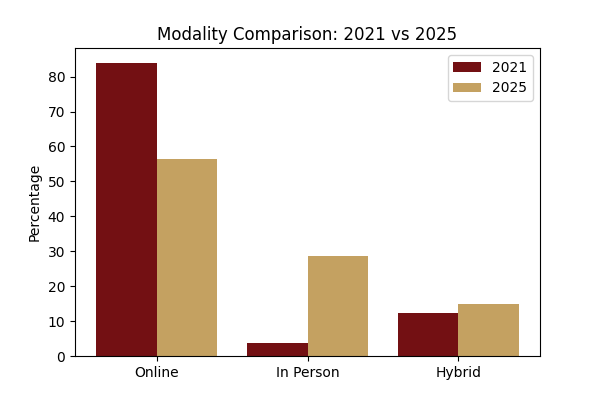
Today, students actively use all three formats – online (57 percent), in person (29 percent) and hybrid (15 percent) – demonstrating what Adhulur describes as a “healthy mix of learning options” that reflects OCCC’s flexibility.
It is important to note that students often enroll in multiple formats at once. For example, a single student may take online, in-person and hybrid courses during the same semester, which is why modality percentages exceed 100 percent. The overall headcount represents each student only once.
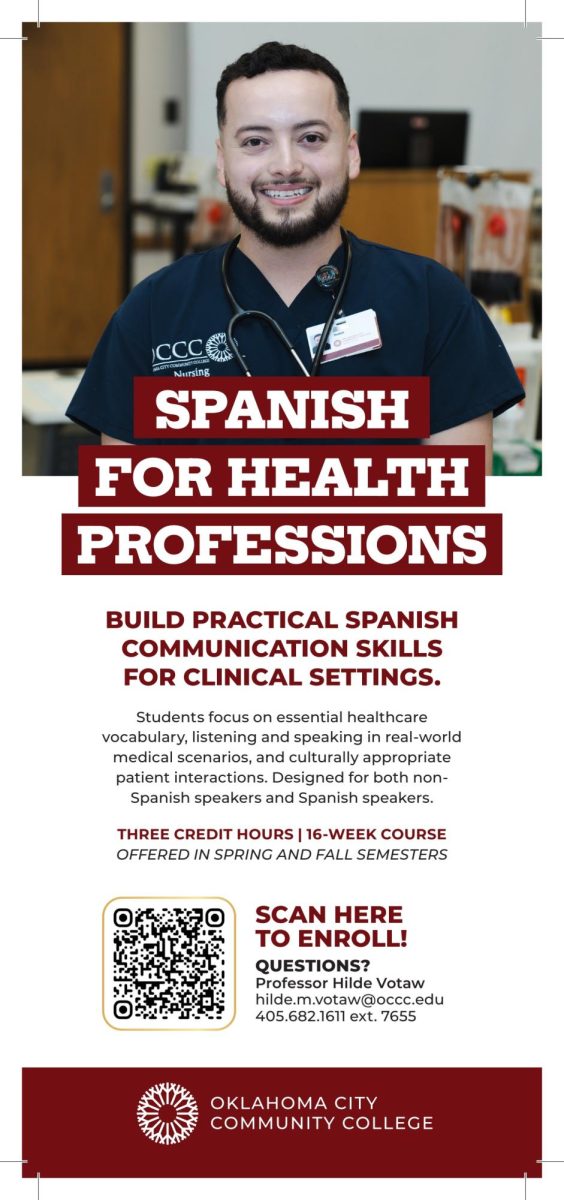
Enrollment growth is also visible across academic divisions. Arts, English, Humanities and Design increased by 12.4 percent from 4,301 students in the spring of 2022 to 4,835 in the spring of 2025. Business and Information Technology jumped 24.2 percent from 1,905 to 2,365 students during the same period. Health Professions showed some of the strongest gains, rocketing 51.8% from 1,028 students in the spring of 2022 to 1,560 in the spring of 2025, reflecting growing interest in healthcare careers.
Science, Engineering and Math inched up 1.4 percent from 4,886 students in the spring of 2022 to 4,954 in the spring of 2025, while Social Sciences climbed 16.5 percent from 4,400 to 5,125 students during that same three-year span.
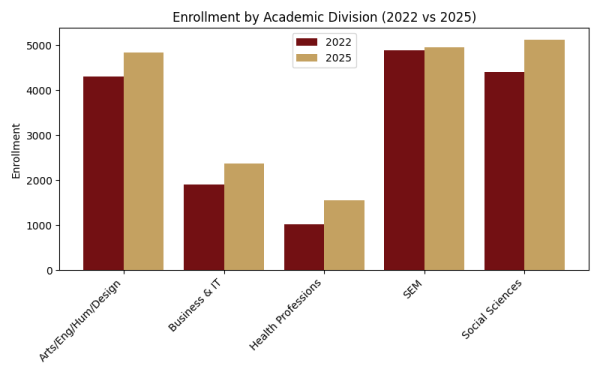
Because many students take courses across multiple divisions, these totals overlap, but together they illustrate broad-based recovery and renewed engagement across disciplines.
Adhulur noted that these trends demonstrate more than just enrollment growth. They show how OCCC has successfully transitioned back to normal campus operations while preserving the flexible learning options students value. The combination of online, in-person and hybrid formats allows students to balance education with work, family responsibilities and other commitments, making college more accessible to a wider population.
The data also reflects a shift in student priorities toward practical education pathways. Growth in areas such as Business and Information Technology and Health Professions points to strong interest in programs tied directly to workforce needs. At the same time, continued enrollment across arts, sciences and social sciences underscores OCCC’s role in supporting both career preparation and academic transfer.
While the spring of 2022 marked the lowest point in enrollment, the steady rise through the current semester suggests positive momentum moving forward. Adhulur emphasized that OCCC’s focus on affordability, flexibility and student-centered programming has been central to this recovery. As students continue to seek adaptable learning environments and career-relevant education, OCCC appears well positioned to sustain its growth and serve as a vital access point to higher education in the Oklahoma City area.