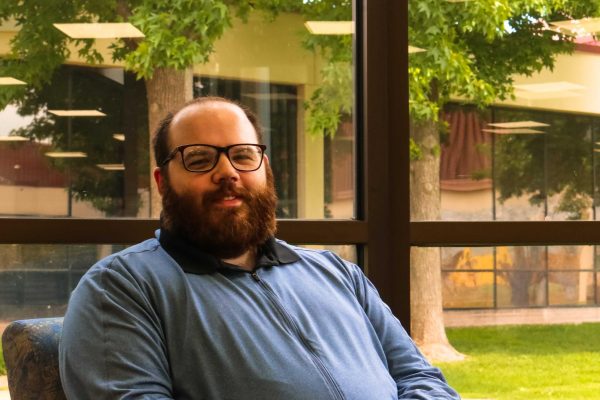



















What do you do when you lack a voice with which to express yourself? This is a question that I have grappled with for most of my life. I wouldn’t say that I lacked the ability to have a voice, but rather that I lacked the confidence to find it. Confidence is a trait I still struggle with. Despite this challenge, I found my voice not through my own strength of will, but rather through being uplifted by others.
To understand the significance of this situation, I think it’s necessary to explain the lack of confidence that has plagued me since childhood. Part of my struggles with confidence stem from the psychological ailments that afflict me.
The first, and perhaps most influential, mental health issue I was diagnosed with was major depressive disorder at the age of 15, although I had been showing clear signs of the condition since the age of 10. As with many who have this illness, I struggle to see myself in any positive light, the result of which is chronic self-doubt.
I am not defined by my troubles, but I am partly shaped by them. Self-doubt has become so deeply ingrained in me that, rather than overcoming it, I have had to find ways to work around it.
For example, every time I turn in an assignment, I assume that I’ll do poorly, even though I almost never do. So I’ve made something of a running joke out of the situation to those who know me well enough.
“Knowing myself,” I’ll say, “I’m going to assume an F and make an A.”
Humor is a tool I use for combatting my lack of confidence, but I would say that my “tool belt,” so to speak, could not exist without the people in my life who believe in me. SCMS (Students Connecting with Mentors for Success), professors, family, friends, colleagues – all are groups of people who have helped me find my voice.
I’d say that I started to find my voice during my second semester at OCCC. I credit my English Composition II professor, Jonathan Khalilian, and the passion he had for language, which felt infectious in a good way. That was the first class where I enjoyed writing essays, a trend that has continued through the rest of my classes up to this point.
I’ve always had a knack for writing, but it took that enjoyment aspect to truly put me on a path toward finding my voice. From that class onward, though self-doubt ever loomed in the background of my subconscious, I never felt too worried about any assignments that involved writing.
Eventually, I enrolled in the British Literature II class taught by Professor Jacob Nelson, where I experienced writing-related anxiety for the first time since I had taken English Composition I. I made an 85 out of 100 on my midterm, and though that doesn’t sound bad, it was the lowest grade I had gotten on any essay since my first semester, so I began to worry. Self-doubt was telling me that I was starting to slip, that I was losing my touch and that I should quit.
Nelson, however, provided good feedback, which I took to heart. What resulted from that experience was, quite possibly, the best essay I have ever written. It was about the novel “1984” by George Orwell, and the focus was on the role of art and culture in combatting oppressive systems.
I ended up nearly acing that final essay, making 98 out of 100, and – with Nelson’s encouragement – I had once again regained some confidence in my writing ability.
Around the same time, I had submitted a small essay to The Pioneer in response to what I felt was the First Amendment – specifically the separation of church and state through the Establishment Clause – being ignored by the Oklahoma state government at the time. Melissa Davis, the staff advisor and editor for The Pioneer, was impressed by my submission and reached out to me, asking if I would consider working for the student newspaper.
The self-doubt came creeping back in, telling me that I shouldn’t take the job for a variety of reasons. I settled on a compromise: I told Davis that I would take the position, but I wanted to do some volunteer articles first. That way, I appeased the part of me that felt unworthy by not immediately taking the job while also knowing that if I did well enough, I would have the justification needed to ignore my personal doubts.
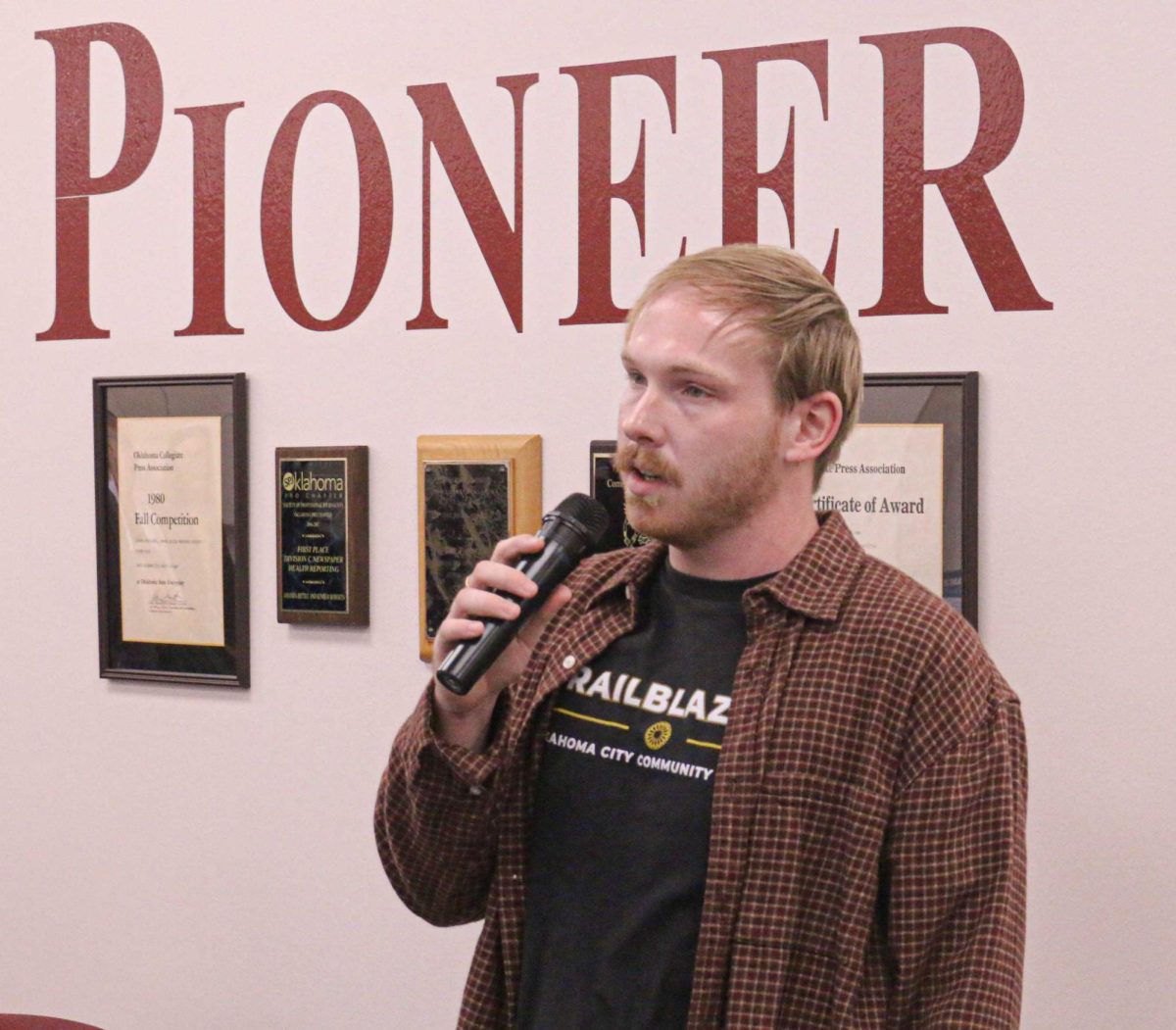
Now, almost a year later, I regret nothing about taking the job with The Pioneer. The enjoyment that I derived from writing, originally fostered in Khalilian’s class, set me on this path. The encouragement that I received from Nelson and others pushed me further down that road. But it is the sense of purpose I have found at The Pioneer that has truly given me my voice.
For me, finding my voice was never about expression for its own sake – it was about expression with purpose. Through The Pioneer, I have written about things that genuinely seem important, and I truly feel as if I have made a difference, in my own small way, during my time here.
We all need to feel seen and heard, and it is through a series of unique – sometimes tragic and sometimes sublime – circumstances that I can say I do feel seen and heard, and that I am making a difference in the process.