








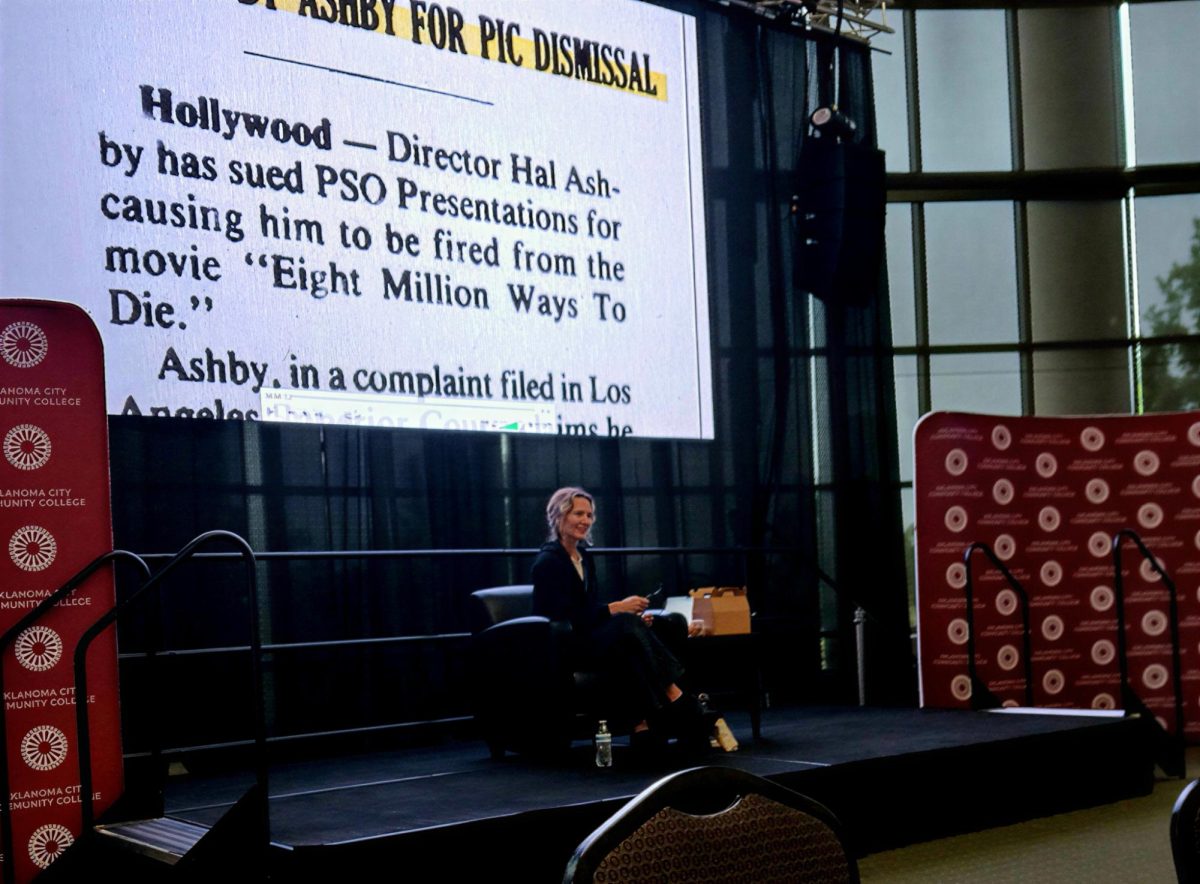











Calling today’s politics “pretty ugly” but far from unprecedented, political strategist Karl Rove recently told a large audience at OCCC that the United States has survived even more divisive eras and can do so again.
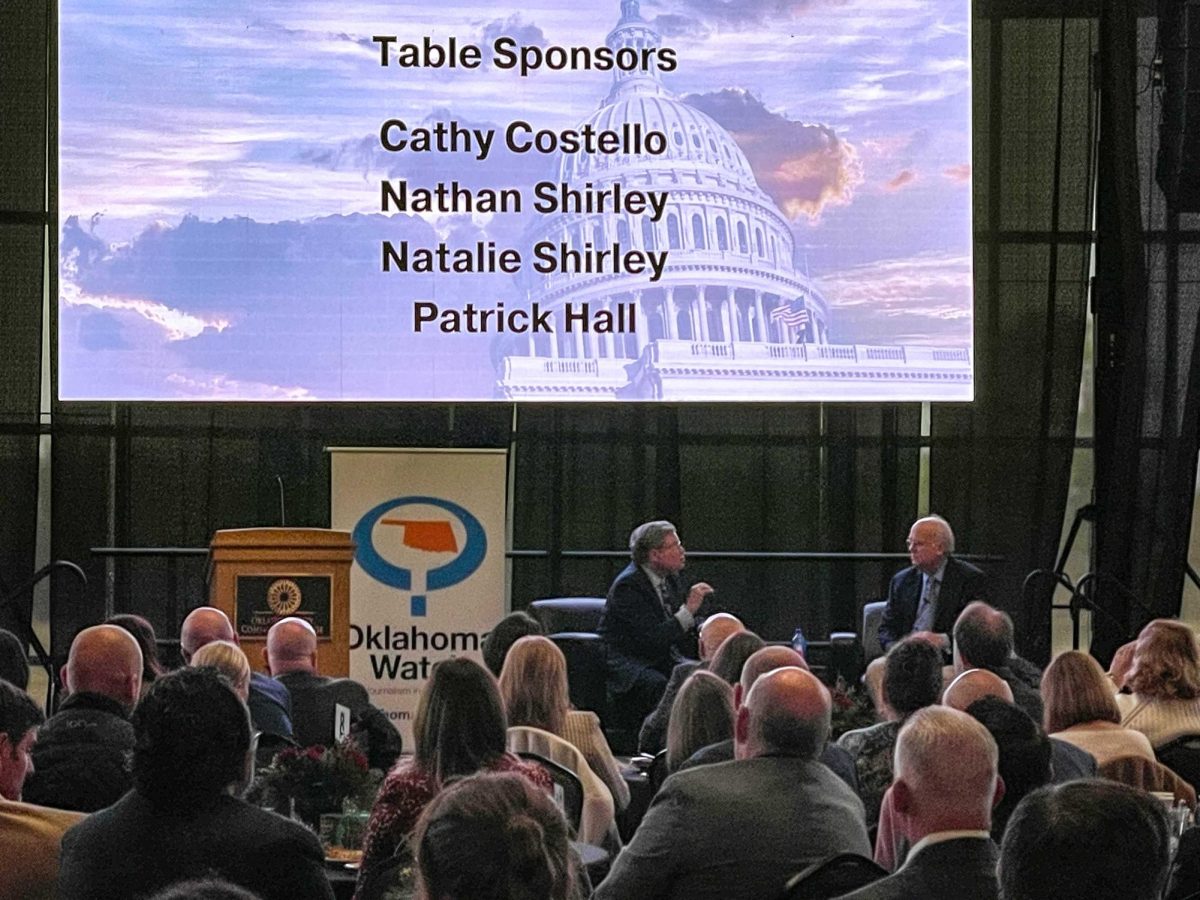
Rove, former senior advisor and deputy chief of staff to President George W. Bush, spoke at a Dec. 4 fundraising event sponsored by Oklahoma Watch, a nonprofit media outlet focused on public service journalism. The program featured Rove’s keynote address followed by a short Q&A segment between Rove and Dick Pryor, general manager of KGOU Radio.
“Pretty ugly, isn’t it?” Rove noted when asked how many in the crowd were happy with the current state of American politics. “Divisive, polarized, nasty, mean, unconstructive. But I got good news for you: We’ve been here before. It’s been worse before, and we made our way through it, and we’ll make our way through it this time around.”
Rove opened his remarks with a series of historical vignettes meant to show that while today’s politics feel dysfunctional, the country has endured and recovered from worse. He pointed to the unrest of the 1960s and 1970s, when civil rights protests turned violent, the Vietnam War fueled mass demonstrations, and national leaders including President John F. Kennedy, Martin Luther King Jr. and Sen. Robert F. Kennedy were assassinated. He reminded the audience that National Guard troops opened fire on students at Kent State University in 1970 and that extremist groups carried out hundreds of domestic bombings in the early 1970s.
He then moved backward to the 1930s, describing the economic upheaval of the Great Depression and the rise of populist movements on both the left and the right. From there, he went to the Gilded Age, his “favorite” era of broken politics, when post–Civil War resentments spilled into congressional fighting, elections were marred by widespread fraud, and a disputed 1876 presidential contest was decided only after a special commission awarded the White House to Rutherford B. Hayes.
Rove also recalled the deadlocked presidential election of 1800, when a tie in the Electoral College between Thomas Jefferson and Aaron Burr took 36 failed ballots in the U.S. House before Jefferson finally prevailed on the 37th. When compared with the tactics deployed back then – including repeated roll calls, members refusing to answer so no quorum could be recorded, and even a congressman brandishing a Bowie knife on the House floor – he suggested that recent House speaker fights and social media feuds look less apocalyptic than they seem.
“Yeah, we’re screwed up today,” Rove said. “I’ve never seen anything like it, and neither have you. Who thought we’d have to wake up and see tweets from the president of the United States at 1 a.m. in the morning?”
When Pryor joined him on stage for questions, he asked Rove what issues leaders should focus on that are both urgent and fixable. Rove pointed first to the federal debt and the long-term sustainability of Social Security and Medicare, warning that both programs are on track to exhaust their trust funds within the next decade if no changes are made. Under current law, he said, an empty Social Security trust fund would trigger an automatic across-the-board benefit reduction tied to incoming revenue, cutting payments for all recipients.
“Our biggest advantage in dealing with these issues is time,” Rove said, “and we’re running out of time.”
He also argued that the United States now faces a more dangerous international environment than it did in the early 2000s, pointing to Russia’s war in Ukraine and what he described as an alignment between Russia, China, Iran and North Korea. Iranian drones and North Korean support have become integral to Russia’s military effort, he said, likening the situation to the Axis powers of Germany, Italy and Japan in the late 1930s and insisting that American leadership is necessary to avoid a larger global conflict.
Pryor then pressed Rove on whether today’s polarization could be eased through structural changes or whether the problem is more personal. Rove said the culture in Congress has to change one relationship at a time.
Rove described a fundraiser for U.S. Rep. August Pfluger, a Republican and former fighter pilot, where a local activist referred to Democrats as communists. According to Rove, Pfluger cut in to say that Democrats are “not our enemies” but political opponents and colleagues, and that members of Congress have a responsibility to treat one another that way. Rove said Pfluger and a bipartisan group of veteran lawmakers have agreed to meet regularly for meals while committing to work on at least one piece of legislation each year with someone from the other party.
To illustrate that bipartisan deal-making is still possible, Rove pointed to the CHIPS and Science Act, which supports domestic semiconductor manufacturing, and the recent federal infrastructure package. He said both measures began with cross-party conversations in the Senate rather than as top-down White House initiatives, with lawmakers from both parties pushing the bills forward despite partisan pressure.
“From left to right, it’s screwed up. From top to bottom, it’s screwed up,” Rove said of the current political climate. “We’ve got performance artists rather than leaders in many instances. And everybody’s to blame.”
Still, Rove argued that most members of Congress would rather solve problems than chase social media attention, predicting that eventually voters will demand a course correction.
“Nobody raised their hand at the beginning” when asked who was happy with American politics, Rove reminded the crowd. “At some point, we’re going to get to a moment, and we’re going to say, ‘Enough is enough.’”
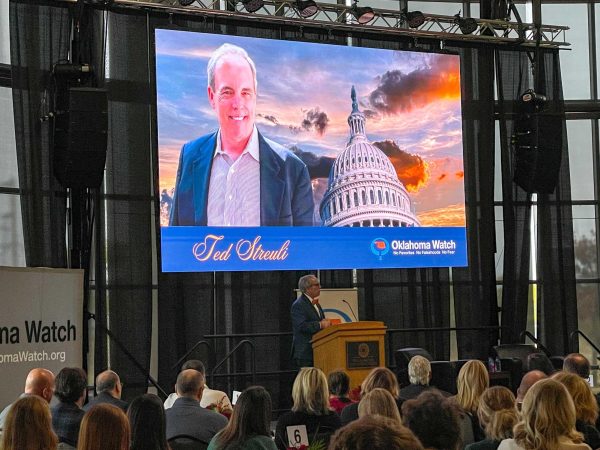
After the conversation, Oklahoma Watch Executive Director Ted Streuli took the stage to connect Rove’s themes to the role of local journalism. Streuli noted that even as trust in “the media” has fallen in national polls, people consistently say they trust local outlets more than national ones. He said Oklahoma Watch does not choose stories based on party or clicks but on how many people are affected, what is standing in the way of a solution and what might change if a problem is brought to light.
Streuli cited reporter Jake Ramsey’s work on Oklahoma’s high eviction rates, Jennifer Palmer’s reporting on Superintendent Ryan Walters’ spending on out-of-state political consultants and J.C. Hallman’s coverage of homeowners insurance premiums as examples of stories that matter regardless of how readers vote. The goal, he said, is not to uncover a Republican problem or a Democratic problem but an Oklahoma problem, and to shine a “big spotlight” on it so officials are pushed to act.
“Whether you’re a Democrat, a Republican, a Libertarian, an Independent, you’re an Oklahoman,” Streuli said. “And you benefit directly when we investigate the problems facing our state.”
Tracing the word “publication” back to the Latin “publicare,” meaning “to make public,” Streuli said journalists are simply members of the public doing a specific job.
“We are genuinely of the people,” he said. “And we are of this state. More importantly, we are for the people, for the public and for this state.”
He closed with a fundraising appeal, joking that when people ask what he is up to, he tells them he is “saving democracy and begging for money.”
Oklahoma Watch relies on donations and grants to fund its operations, and Streuli noted that contributions made during the event would be matched two-to-one by national donors. He urged attendees to consider giving and thanked OCCC, sponsors and guests for helping the organization keep “the public’s business public” in the coming year.