














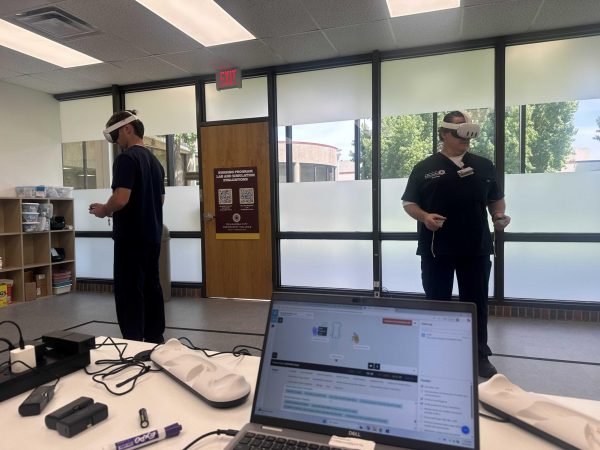
The OCCC Division of Health Professions is taking learning to the next level with the help of virtual reality. What once sounded like a science fiction idea has now become an important part of how students in health programs learn, practice and prepare for their careers.
Dean of Health Professions Kathy Wheat and Director of Anesthesia Technology Bryan Fulton, who doubles as coordinator of the simulation center, recently explained how this technology is changing education for students at OCCC.
Wheat has worked at OCCC for more than 10 years and oversees nine health programs. She said that all students in the division learn through three main methods: classroom lessons, lab or simulation training and clinical practice in real healthcare settings. The new VR tools add another layer to that process.
“Virtual reality gives students a chance to make mistakes safely before they go out into real hospitals or clinics,” Wheat explained. “It supports and strengthens everything they learn in class and lab.”
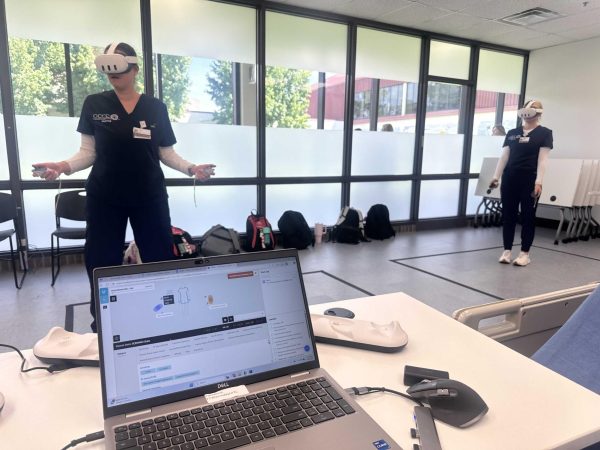
Fulton, who has a strong background in anesthesia and simulation education, said that the idea of bringing VR to OCCC started a few years ago through an internal innovation grant. His team proposed using a program called SIMVANA, which focuses on immersive VR simulations for healthcare training. The program was first used in the Instrumentation I course to help students understand the anesthesia gas machine. Students practiced with real machines in the lab and then used VR to reinforce what they had learned.
“That’s really how it began,” Fulton said. “We started small in one program, saw how helpful it was and then expanded to the nursing and physical therapist assistant programs.”
He explained that the pandemic also played a major role in pushing the college toward more creative learning tools. When classes went online, faculty saw that virtual learning could still be effective and decided to continue developing new ways to use technology even after students returned to campus.
Now, VR is being used in several programs. Nursing students, for example, use it to practice communication skills in mental health settings and end-of-life care scenarios. These experiences help students learn how to talk to patients and families in emotional situations, something that can be difficult to experience during regular clinical rotations.
“It’s great when students can make a mistake in VR and just reset it with a button,” Fulton said. “It builds their confidence before they ever work with real patients.”
Both Wheat and Fulton said that the feedback from students was very positive. Students report that they feel more engaged and confident after completing the virtual training. Faculty members have also noticed that students are more willing to ask questions and think critically about what they are learning.
Implementing new technology does come with challenges, however. Fulton said that the college has to make sure internet connections are strong enough to support multiple VR sessions at once, especially when thousands of students are on campus. The staff also has to plan carefully to make sure there is enough physical space for students to move safely while using VR headsets.
Still, both Wheat and Fulton agreed that these are normal parts of the process, not major barriers. OCCC works closely with its information technology department and outside vendors to solve issues quickly so that students can have the best experience possible.
Wheat said the main goal is to give students every chance to succeed and feel prepared for their future careers.
“The most important thing for a student is to stay curious,” she said. “If you keep asking questions and want to learn everything you can, you’ll be successful.”
Fulton shared a similar message.
“Be your authentic self, and be open to learning,” he said. “You don’t have to know everything right away. It’s okay to make mistakes – that’s how you grow.”
With the dedication of its faculty and the help of modern technology, OCCC’s Health Professions Division is preparing students not just for today’s healthcare jobs but also for the future. Virtual reality is giving students a safe and exciting way to learn, build confidence and step into their careers ready to make a difference.