

















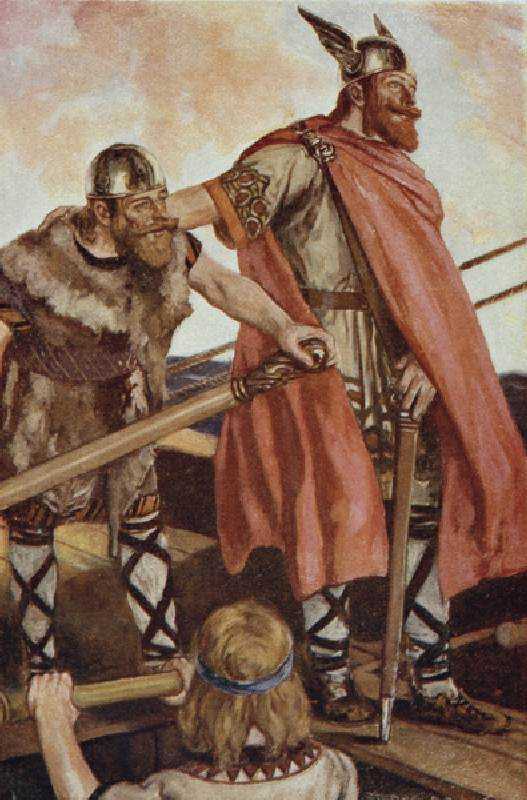
Inspired in part by its upcoming study abroad trip to Iceland, OCCC will host three guided reading sessions focused on Icelandic sagas. The sessions are supported by the OCCC Plus program, giving students who attend the opportunity to enter a raffle for a scholarship.
The sessions, led by OCCC Professor of English Jeffrey Provine, will explore Icelandic literature through discussions based on different works. The sessions are free and open to OCCC students as well as members of the community who are interested in learning more about Icelandic culture and storytelling traditions.
According to Provine, the sessions were designed to work in tandem with OCCC’s study abroad trip to Iceland scheduled for May, creating opportunities for students to engage with the country’s culture and history before the trip.
By completing the OCCC Plus event, students will be entered into a raffle for a scholarship. The scholarship offered through the program is a three-credit-hour tuition waiver, Provine said. He added that several students planning to participate in the Iceland trip have also expressed interest in attending the reading sessions.
While the study abroad trip helped inspire the program, Provine said the decision to focus on Icelandic sagas also came from broader discussions about how literature could be used to highlight Icelandic culture.
“Though they are related, (Chair of English) Jacob Nelson and I did have a lengthy discussion about how we could tie OCCC Plus with the study abroad trip,” Provine said. “Literature is of course a go-to for the English department, and the sagas of Iceland stand out as a great emblem of Icelandic culture.”
Icelandic sagas, which were originally passed down orally before being written centuries ago, offer a different perspective on what constitutes literature, Provine said.
“When people typically think ‘literature,’ their minds usually turn to epic novels,” he said. “But sagas show that great stories have been around for millennia, even if they had different forms.”
Provine also pointed to the influence Icelandic sagas have had on literature and historical understanding, particularly during periods of increased international interest in Icelandic culture.
“When Icelandic culture had waves of international interest in the late 1800s and, especially, in the mid-20th century, the sagas brought more legitimacy to family and local histories,” Provine said. “They gained credence by having lasted for so long and telling grand tales, such as the settlement of Greenland and exploration of North America, but they also show that all generations have captivating stories to tell.”
The idea for the reading sessions came from previous OCCC Plus programs and discussions about expanding those offerings.
“The idea spun off from the OCCC Plus readings last year led by (Professor of English Stacie) Warner,” Provine said. “Nelson suggested we do something that would tie in with the Iceland study abroad trip. Sagas, of course, were quick to come to mind.”
Each session will follow a similar format, Provine said. Discussions will begin with a brief presentation providing background on the saga, followed by a summary of the reading and guided open discussion. Provine noted his excitement to hear attendees’ thoughts on the sagas.
The sessions will be held from 2:30 p.m. to 3:30 p.m. in Room 2G8 at the World Languages and Cultures Center. Provine said WLCC Coordinator Chiaki Troutman had worked closely with organizers to plan the events and secure funding for refreshments.
The first session will take place on Feb. 19 and will focus on “Hrafnkels saga freysgoða” (“The Story of Hrafnkell, Frey’s Priest”), translated by John Coles in 1882. The second session, scheduled for March 4, will cover “Eiriks saga rauda” (“The Story of Erik the Red”), translated by J. Sephton in 1880. The final session will be held April 9 and will examine “Bandamanna saga” (“The Story of the Banded Men”), translated by William Morris and Eiríkr Magnússon in 1891.
Beyond literary discussion, Provine said he hopes students gain a deeper appreciation for history and storytelling.
“I also hope that attendees will take away the lesson that we are always writing our own histories,” he said. “And, perhaps someday, people will be looking back at our own stories in awe.”